How to read a congressional Periodic Transaction Report (PTR), field by field
A Periodic Transaction Report looks like a dull form. Once you know its seven fields, it tells you who traded what, when, roughly how much, and how long they waited to say so.
The seven fields
- Owner — blank for the member,
SPspouse,JTjoint,DCdependent child. - Asset — the company or instrument name, usually with the ticker in brackets, e.g. Microsoft Corporation (MSFT). Options show the underlying plus strike and expiry.
- Transaction type —
Ppurchase,Ssale,S (partial)partial sale,Eexchange. - Transaction date — the day the trade happened.
- Notification date — when the member says they learned of it (relevant for managed accounts).
- Amount — a range, never an exact value.
- Filing date — stamped by the Clerk or Secretary; the clock that the 45-day rule is judged against.
Reading the owner column
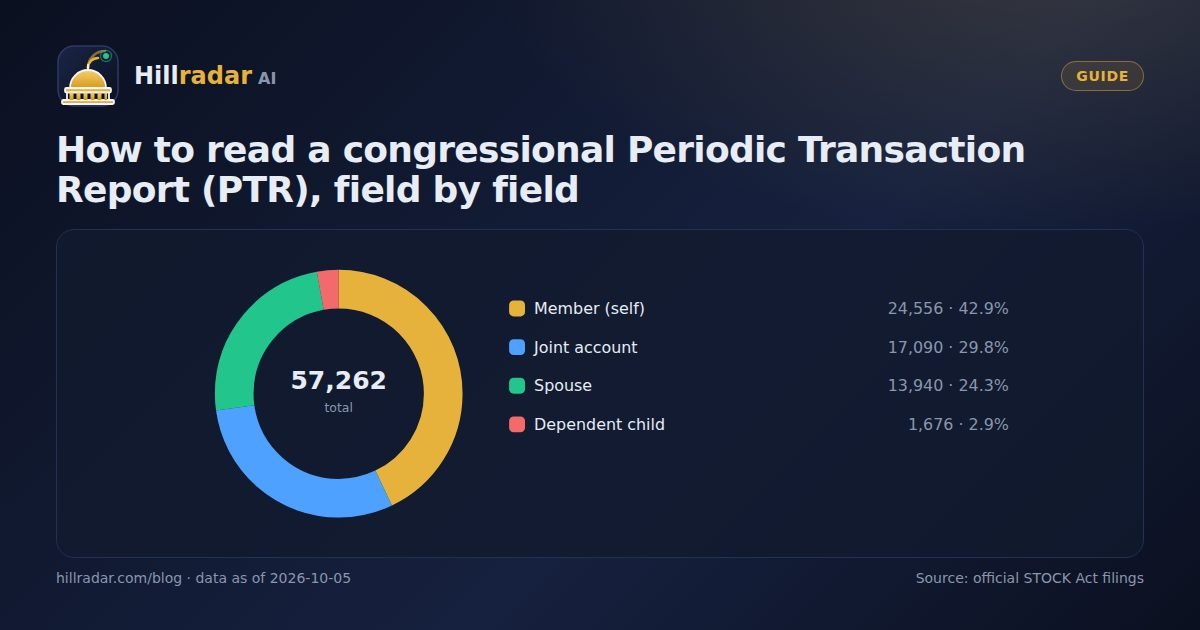
The owner code changes how a trade should be read. A spouse's trade can be in an account the member has no control over, while a joint account implies shared decisions. In our data only 43% of transactions are the member's own; the rest are joint, spouse or child accounts. The Senate record skews even further: senators' own accounts make up a much smaller share than in the House, where self-owned trades dominate.
Asset names and tickers
Most filings name a listed company and its ticker, which is what lets a tracker group trades by stock. But 17% of transactions in our database have no ticker: Treasury bills, municipal bonds, private funds, real-estate partnerships and crypto. They are still real transactions and still show up, but they are excluded from stock-only statistics such as which companies Congress trades most.
Purchase, sale, partial sale, exchange
Across the whole record there are 29,368 purchases and 27,892 sales, a ratio close to one. A lawmaker whose filings are mostly S (partial) is usually drawing down a position over time, often through a financial adviser, not making a series of bearish calls. Exchanges are rare (2 in total) and usually reflect a merger or a fund conversion rather than a decision.
The amount range
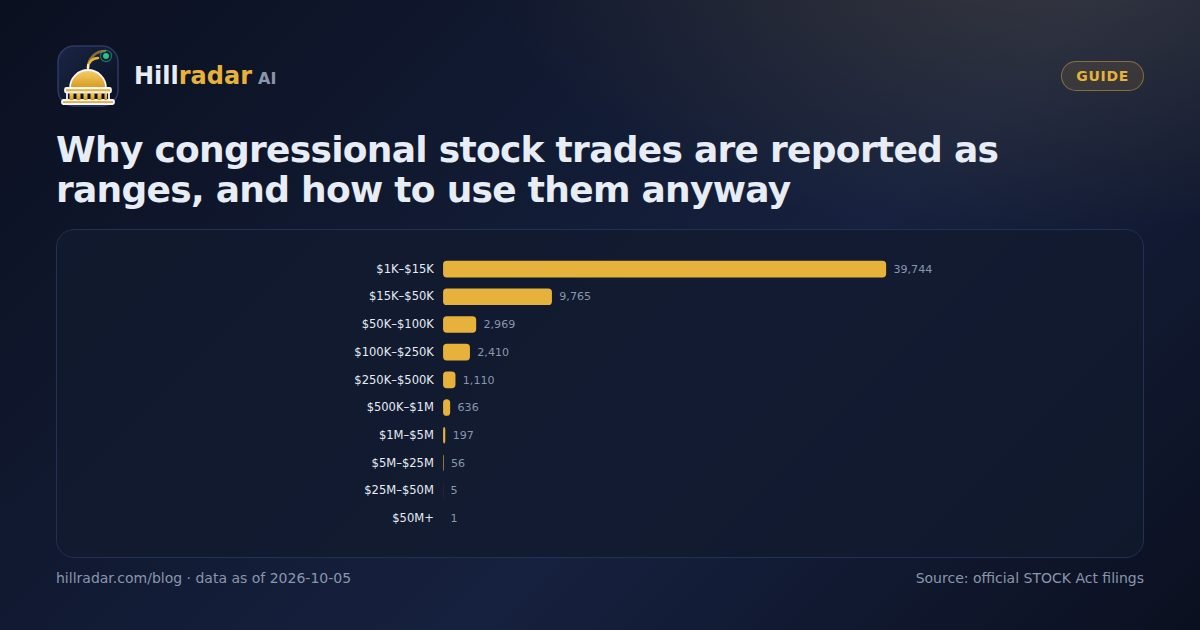
Ranges are the most misread field. $15,001–$50,000 does not mean around $30,000; it only tells you the true figure lies somewhere in that band. 69% of all transactions are in the smallest band. When Hillradar AI shows a "volume" for a lawmaker or a company, it is an upper bound built from the top of each band, and labelled as such. Here is why the ranges exist and how to use them.
Two dates, one gap
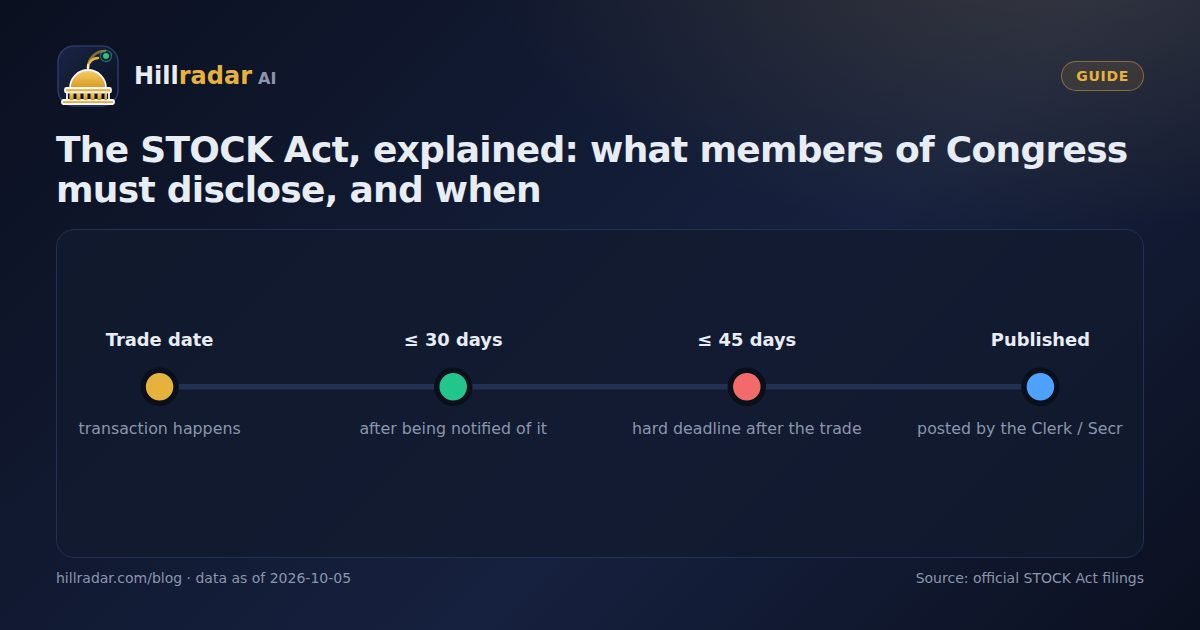
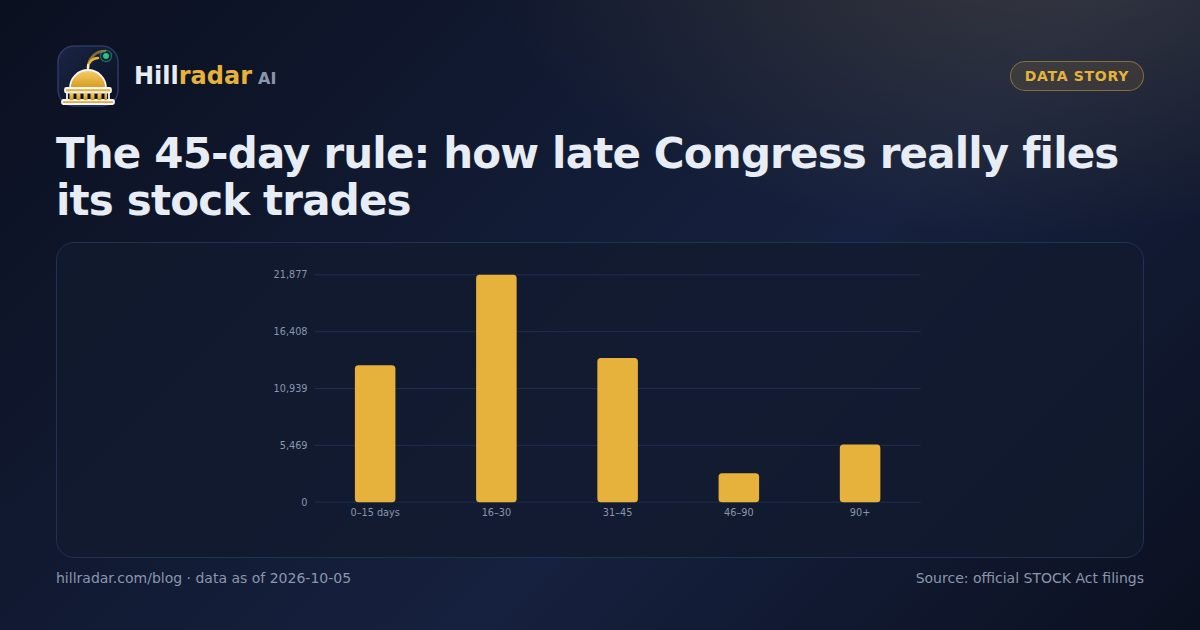
Subtract the transaction date from the filing date and you get the disclosure delay. The median is 27 days; anything above 45 is late under the Act. We print that number on every record because it is the fastest way to judge how fresh the information was when the public first saw it.
Common pitfalls
- Treating the midpoint of a range as the trade size.
- Counting a partial sale as 'selling out' of a company.
- Ignoring the owner code and attributing a spouse's managed-account trade to the member's judgment.
- Reading a late filing as a recent trade: always check the transaction date, not just the publish date.
A worked example, line by line
Take a representative filing: SP · NVIDIA Corporation (NVDA) · P · 09/02/2026 · 09/15/2026 · $15,001–$50,000, filed 09/30/2026. Reading left to right: the spouse's account bought NVIDIA on 2 September; the member says they were told on 15 September; the amount is somewhere between $15,001 and $50,000; the public saw it on 30 September, 28 days after the trade and inside the 45-day limit. What you do not know: the price paid, the number of shares, whether an adviser made the call, or whether the household already held NVIDIA. A tracker that shows "Rep. X bought $50,000 of NVIDIA" has overstated the filing twice, once on the amount and once on who decided.
PTRs versus the annual financial disclosure
Periodic Transaction Reports are only half of the picture. Every member also files an annual financial disclosure each May covering the previous calendar year: assets held (again in ranges), income, liabilities, positions and gifts. The annual report tells you what a member owns; the PTR tells you what changed and when. Serious research uses both: a PTR showing a $250,001–$500,000 sale means something different for a member whose annual report shows a $5 million portfolio than for one whose total holdings are under $100,000. Trackers such as this one are built on PTRs because they are timely; for holdings, the annual reports on the Clerk and Senate sites remain the source.
Where parsing goes wrong
Most errors in any congressional trade database come from three places. Scanned filings, common in older House years, need optical character recognition and sometimes misread tickers or dates. Non-standard asset names, such as a company written without its ticker, must be matched by name and can be mis-matched. Amendments add a second record for the same trade unless de-duplicated. In our database of 57,262 rows, every record keeps a link back to its filing so a reader can check the original, and amendments are merged by lawmaker, asset, date and amount. If you spot an error, the Contact page explains how to report it; corrections are reviewed within a business day.
Frequently asked questions
What do SP, JT and DC mean on a filing?
They are owner codes: SP is the member's spouse, JT a joint account, DC a dependent child. A blank owner means the member themself.
Why do some filings list a company without a ticker?
Bonds, municipal debt, private funds, real estate partnerships and some foreign securities have no exchange ticker. They are still reportable and still appear in trackers, usually flagged as non-stock assets.
Is a 'sale (partial)' different from a sale?
Yes. The member sold part of the position and still holds the rest. It is still recorded as a sell in trackers, which is why sells can outnumber buys for a lawmaker who is slowly exiting a holding.
Hillradar AI republishes public STOCK Act disclosures for research and education. Figures come from the official filings as collected in our database on the date shown; filings can be amended by the filer. Nothing here is investment advice.