The STOCK Act, explained: what members of Congress must disclose, and when
Every row in a congressional trade tracker exists because of one 2012 law. Here is what it requires, where its limits are, and how the filings become public data.
Where the law came from
The Stop Trading on Congressional Knowledge Act was signed in April 2012 after a wave of reporting on lawmakers trading around market-moving information. Its core idea is simple: members of Congress already owed the public an annual financial disclosure, but a once-a-year snapshot said nothing about when a stock was bought or sold. The STOCK Act added a near-real-time layer, the Periodic Transaction Report (PTR), and confirmed that insider-trading law applies to Congress like anyone else.
Who has to file
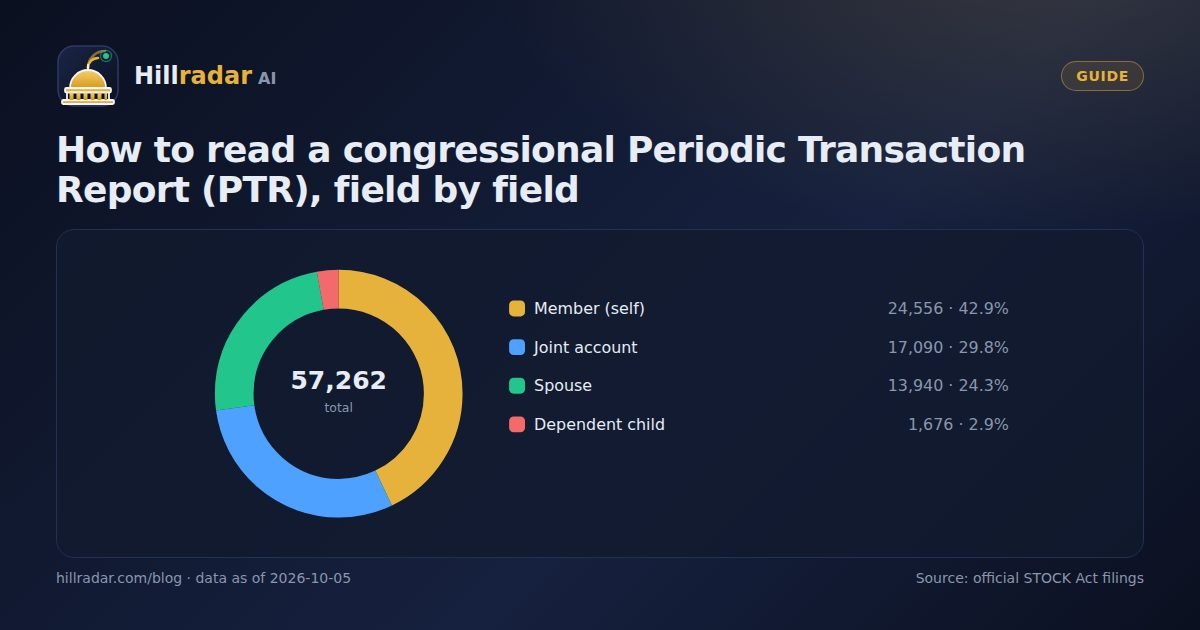
All 100 senators and 435 voting representatives, plus delegates, file. So do senior staff above a pay threshold, the President and Vice President, and senior executive officials. Crucially, a member's report also covers transactions by a spouse and dependent children, and jointly held accounts. In our database of 57,262 transactions, 24% are marked as a spouse's trade and 30% as joint accounts, so skipping those would hide a large share of the record.
What has to be reported
- Any purchase, sale or exchange of a stock, bond, commodity future, option or other security over $1,000.
- Mutual funds and ETFs are generally exempt from PTRs when they are widely diversified, though many members report them anyway. Treasury securities and cryptocurrency positions do appear in the filings in practice.
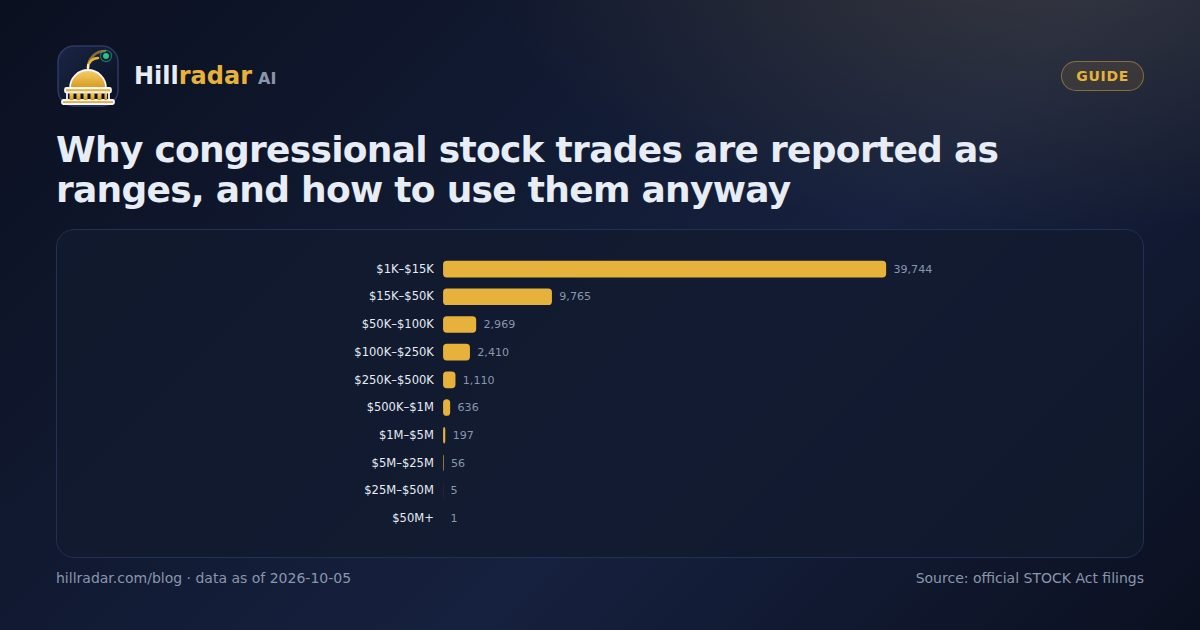
- The amount is reported as a range, not an exact figure: $1,001–$15,000, $15,001–$50,000, $50,001–$100,000 and so on up to over $50,000,000.
The 45-day deadline
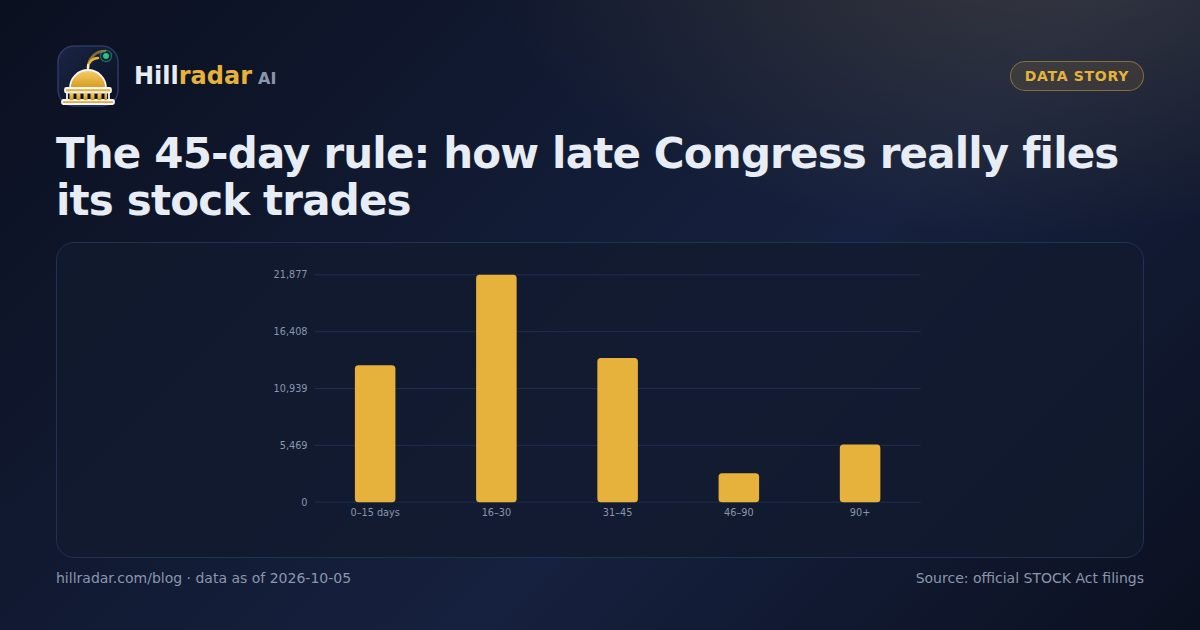
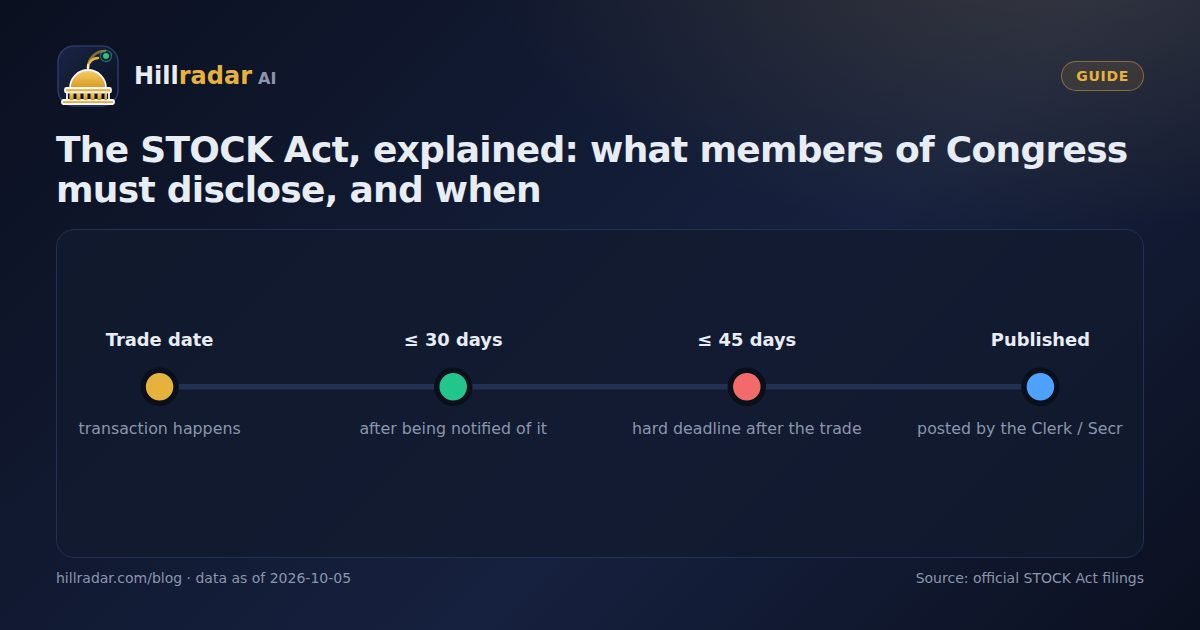
A PTR is due within 30 days of the member being notified of a transaction and no later than 45 days after the trade itself. That window is why a tracker always shows two dates. Across our record the median gap between a trade and its filing is 27 days, but 14.6% of transactions (8,337) were filed after the 45-day mark, and 5,548 arrived more than 90 days late. The statutory late fee is $200.
Where the filings are published
House members file with the Clerk of the House, whose Financial Disclosure site publishes PTRs as PDFs with a machine-readable index. Senators file with the Secretary of the Senate through the electronic Financial Disclosure (eFD) system. Both are public and free, but neither offers search across lawmakers, companies or dates, and older Senate filings are scanned paper. That is the gap services like Hillradar AI fill: we parse the filings into a database of lawmakers, companies, dates and amounts, and link each row back to its source.
What the law does not give you
- No exact amounts, only ranges (most filings, 69%, sit in the smallest $1,001–$15,000 band).
- No reason for the trade, no price paid, and no statement of who made the decision (a member, a spouse, or a financial adviser).
- A built-in lag: even on-time filings can be 45 days old, and 14.6% are later than that.
- Filers can amend reports after the fact, so numbers in any tracker can move slightly.
Read with those limits in mind, the STOCK Act record is still one of the most detailed windows into the financial activity of any legislature in the world, and it is entirely public. Our next guide walks through a single filing line by line.
How the rules evolved after 2012
The STOCK Act did not arrive fully formed. The original 2012 text required filings to be posted in a searchable, sortable online database. In 2013 Congress quietly repealed that requirement for most staff and kept only the members' obligation, which is why the official sites remain PDF archives rather than databases. Later reforms were mostly procedural: the Senate moved to its electronic eFD system, the House added a machine-readable index, and ethics committees issued guidance on managed accounts and notification dates. Each of these changes shows up in the data as a step change in filing speed, which is one reason comparing years before 2015 with recent years is tricky.
Enforcement has stayed light. The $200 late fee has not been indexed to inflation, there is no public register of fines, and several members have acknowledged filing dozens of transactions months late with no consequence beyond press coverage. That gap between the law's ambition and its teeth is the main argument behind the recurring proposals to ban individual stock ownership by members outright, none of which had passed by the date of this data.
The record in numbers
Twelve years of STOCK Act filings now add up to 57,262 transactions by 352 members, covering 9,742 distinct companies and assets. The busiest single year was 2025 with 8,215 transactions; the quietest full year was 2024 with 3,251. The House contributes 81% of the record. Roughly 17% of transactions involve bonds, funds, options or other assets without a stock ticker, which many trackers silently drop; Hillradar AI keeps them and lets you toggle them on.
Why the disclosures matter even with their limits
Three audiences use this record for different reasons. Voters and journalists use it to check whether a lawmaker's financial interests overlap with their committee work, which is the Act's original purpose. Researchers use it as a rare, long-running data set on how a well-informed group of people actually trades, with the finding that, taken as a whole, Congress does not beat the market. Investors use it as one more public signal, with the understanding that every trade they see is weeks old and stripped of its reasons. In all three cases the value comes from the same thing: the record is official, complete for its scope, and free.
Frequently asked questions
Does the STOCK Act ban members of Congress from trading stocks?
No. It requires disclosure, not abstention. Members may buy and sell securities, but transactions over $1,000 must be reported within 45 days. Several bills to ban or restrict trading have been introduced since, but as of the data date none has replaced the disclosure regime.
Who else is covered by the STOCK Act?
Besides members of Congress, the Act covers senior congressional staff, the President and Vice President, and senior executive-branch officials. Spouses and dependent children of members are included in a member's own reports.
What happens if a lawmaker files late?
The standard penalty is a $200 late fee, which ethics committees can waive. There is no automatic public enforcement, which is one reason trackers flag the gap between trade date and filing date on every record.
Hillradar AI republishes public STOCK Act disclosures for research and education. Figures come from the official filings as collected in our database on the date shown; filings can be amended by the filer. Nothing here is investment advice.