The 45-day rule: how late Congress really files its stock trades
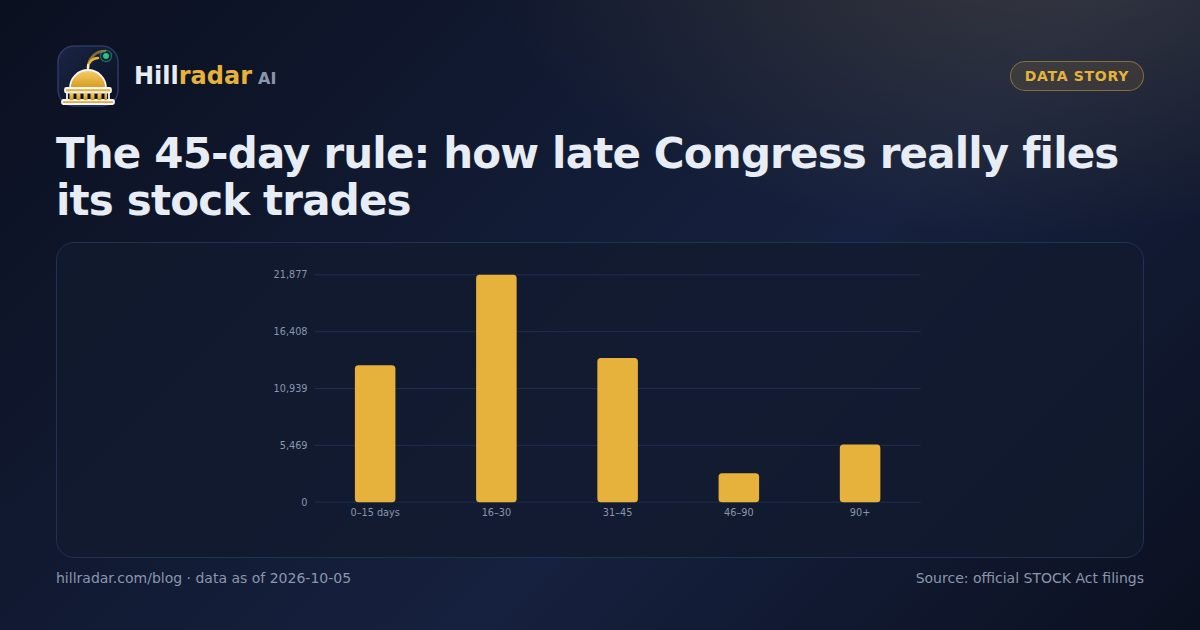
Every disclosure carries two dates. The distance between them is the single best measure of how useful the STOCK Act is in practice. Here is the full distribution.
The distribution
Most members comply. 85.4% of transactions are filed inside the 45-day window, and 20.8% within two weeks. The median delay is 27 days. But the tail is long: 2,789 filings landed between 46 and 90 days, and 5,548 came more than 90 days after the trade. That tail is why the average (55.9 days) is double the median.
Why filings are late
- Managed accounts. A member may not learn of a trade until a monthly or quarterly statement arrives. The 30-days-after-notification rule is meant to cover this, but notification dates are self-reported.
- Batch catch-ups. Many of the 90+ day filings arrive in bundles, where a member discloses months of transactions in one report, often after ethics staff or journalists ask.
- Amended reports. A corrected filing keeps the original transaction date but gets a new filing date, so corrections look late even when the original was on time.
House versus Senate
Senators file faster and are late less often. Part of the difference is scale: the House has 275 filers in our record against 77 senators, and more of the House volume comes from a few very high-frequency portfolios where catch-up filings are common.
The penalty
The Act sets a $200 late fee, which the ethics committees may waive. There is no public ledger of fees paid, and no escalation for repeat lateness. For most readers the practical consequence is informational: a late filing means the market has already moved on by the time the public can see the trade.
How Hillradar AI handles it
- Every trade shows its delay in days; anything over 45 is marked in red.
- Lawmaker profiles report an average filing delay so you can see who is habitually late.
- Alerts fire on the filing date, which is the first moment the information is public, and always show the original trade date alongside it.
- We never backfill alerts for filings older than 30 days, so a catch-up bundle from last year does not arrive as "news".
Next in the series: how the two chambers' disclosure systems differ, from file formats to owner reporting.
Is filing getting faster?
Yes, slowly. The Senate's move to fully electronic filing and the House's machine-readable index both shortened the gap between a member submitting a report and the public being able to read it. The statutory deadline has not changed, but the share of filings landing in the 0–15 day bucket has grown as more offices file as soon as a brokerage notification arrives rather than batching monthly. The tail of very late filings has not shrunk in the same way, because it is driven by a small number of members catching up on long periods at once, and no procedural change fixes that.
The notification-date loophole
The Act's clock has two hands: 45 days from the trade, or 30 days from the member being notified of the trade, whichever is earlier in principle. In practice the notification date is self-reported, and for managed accounts it can be weeks after the transaction. A filing can therefore appear on time against the notification date while being 60 or 70 days after the actual trade. Hillradar AI measures delay from the transaction date, the number that matters to a reader, and ignores the notification date for that purpose. It is the stricter reading, and it is why our late share of 14.6% is higher than figures that use notification dates.
A reader's checklist for late filings
- Check whether the late filing is part of a bundle covering months; if so, the individual trades are old news and the story is the lateness itself.
- Look at the owner code; managed spouse or joint accounts explain most long delays.
- Compare the member's average delay on their profile; a one-off 60-day filing from a habitually punctual member is different from a pattern.
- Remember that the market has already moved; a 90-day-old purchase carries almost no timing information.
Frequently asked questions
What is the average delay between a congressional trade and its disclosure?
Across 57,262 filings the average is 55.9 days and the median is 27 days. The average is pulled up by a tail of filings that arrive months late.
What share of congressional stock trades are filed late?
14.6% of transactions (8,337) were filed more than 45 days after the trade, and 9.7% more than 90 days after.
Which chamber files faster?
The Senate: an average of 41.8 days versus 59.4 in the House, and a late rate of 10.6% versus 15.5%.
Hillradar AI republishes public STOCK Act disclosures for research and education. Figures come from the official filings as collected in our database on the date shown; filings can be amended by the filer. Nothing here is investment advice.